The Long Tom is a field gun used widely by the united states during the world war II era. It has a barrel length of 22 feet and 9 inches, with a 155mm or 6.1 inch caliber. This cannon was used for long range shots.Firing with a maximum velocity of 2,800 ft./s and with a maximum range of 1.6 miles. The Long Tom uses many different types of ammunition such as smoke and deadly chemical releasing shells, Depending on the projectile, ammunition can be fired with anything from TNT (dynamite) too Sulfur trioxide in chlorosulfonic acid. The cannon was often used to fend of attackers before they got to friendly lines. The Long Tom could shoot further all depending on the angle at which it is fired. I is often situated between 30 and 60 degrees to achieve maximum affect.
Thursday, February 12, 2009
1900's-Present M1 155mm Long Tom (Cannon)
The Long Tom is a field gun used widely by the united states during the world war II era. It has a barrel length of 22 feet and 9 inches, with a 155mm or 6.1 inch caliber. This cannon was used for long range shots.Firing with a maximum velocity of 2,800 ft./s and with a maximum range of 1.6 miles. The Long Tom uses many different types of ammunition such as smoke and deadly chemical releasing shells, Depending on the projectile, ammunition can be fired with anything from TNT (dynamite) too Sulfur trioxide in chlorosulfonic acid. The cannon was often used to fend of attackers before they got to friendly lines. The Long Tom could shoot further all depending on the angle at which it is fired. I is often situated between 30 and 60 degrees to achieve maximum affect.
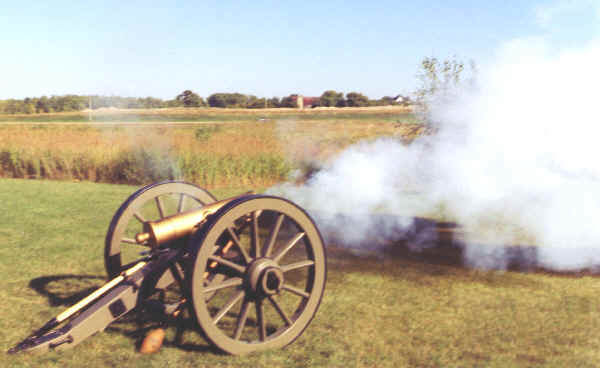
1800's Howitzer (Cannon)
The Howitzer is an artillery weapon known for its very short barrel and great portability. The Howitzer was used to propel smaller shells faster with a steeper angle of decent. Howitzers were originally made in Sweden with the intent of use in siege warfare, Medium Siege Howitzers have a caliber of about 200mm to 220mm with shells weighing about 100 kilograms. Though the Howitzer was further refined in the 1880's, thus crating a newer cannon easier used in armies. It had calibers ranging from 240mm to 270mm with a shell weighing about 150 kilograms.
Pre-1700's Saker (Cannon)
The saker cannon is normally about 9.5 feet long with a 3.25 inch calibre, This cannon most often shoots a 5.25 pound round shot cannonball which is most often propelled by combustion of 4 lbs of black powder. The Saker is set at a 45 degree angle and is not designed to explode when fired or shoot long range. The saker is designed for close range Targets, The shot will bounce along the ground to hit multiple targets. This cannon was also Heavily used during the English Civil War and was greatly effective. Some Pirates used this as well as many official navy's for close range combat and ship boardings.
Thursday, January 1, 2009
Reflection
a. I believe that my cannon had a fairly intelligent design; it brought the volume of the cannon down which should have created more pressure to fire the ball.
b. This idea is classified by Gay Lus Sacs’s law where volume and pressure are directly proportional and Boyles where pressure and temperature were directly proportional.
c. Since my cannon nor any body else’s cannon shot I noticed a large influence by Boyles law, since it was really cold there was not enough pressure to shoot the ball from the cannon.
d. Since my cannon didn’t fire properly I looked at all of the different possibilities of what might have happened, I came to the conclusion that the temperature was the reason why the ball didn’t shoot, To change this I would have shot the ball on a different day.
Subscribe to:
Posts (Atom)
